
May 2025: When Technology Met the Reality of Indian Roads
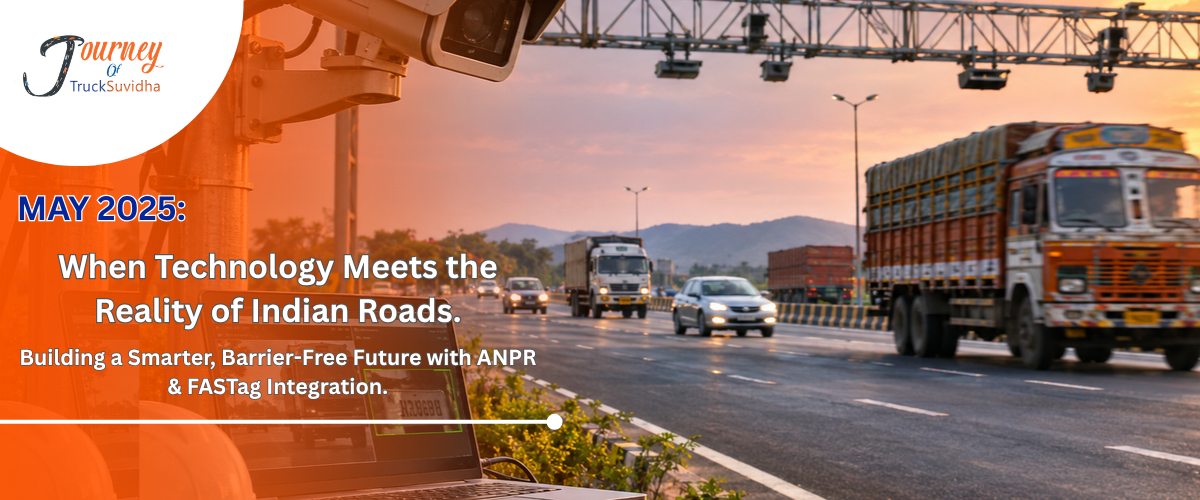
From imagining barrier-free vehicle movement to testing ANPR, FASTag integration and financial transactions under real Indian road conditions.
There is a big difference between building technology on paper and implementing it on Indian roads.
On paper, everything looks simple.
A vehicle approaches.
A camera captures its registration number.
The software identifies the vehicle.
The system connects with the relevant FASTag information.
The applicable financial transaction is processed.
And the vehicle continues moving without stopping.
No barrier. No queue. No unnecessary waiting.
It sounds like a straightforward technological solution.
But when you actually start implementing it on the ground, you realise that the road has its own rules.
And those rules are not always written in technical documentation.
May 2025 was one of the most interesting phases of our journey at TruckSuvidha because our vision of ANPR-based vehicle identification and seamless financial transactions was meeting the reality of Indian infrastructure.
We had moved beyond discussions and presentations.
Hardware was being installed and evaluated.
Software integrations were progressing.
Vehicles were passing through actual testing environments.
We were examining number plate recognition, camera positioning, network connectivity, power requirements and the operational challenges involved in making everything work together.
The dream was gradually taking shape.
But the ground was teaching us lessons we had never imagined.
The Dream Was Never Just About Reading a Number Plate
When we started thinking about ANPR and FASTag integration, our ambition was not to build another camera-based identification system.
ANPR technology already existed.
FASTag was already part of India’s electronic toll collection infrastructure.
Our question was different.
Could these technologies work together to enable actual financial transactions without requiring a vehicle to stop at a physical barrier?
Imagine a highway where a car passes at normal highway speed.
A truck follows behind.
Another commercial vehicle moves through.
The system identifies the registration numbers, validates the relevant information and supports the required transactions without interrupting vehicle movement.
That was the vision we wanted to pursue.
But building such a system meant solving several problems simultaneously.
It was not just a software problem.
It was not just a hardware problem.
It was not just a banking problem.
It was an infrastructure problem involving technology, financial systems, regulations, operations and human behaviour.
And that was where the real journey began.
India Has Millions of Vehicles, but Not Every Number Plate Looks the Same
One of the first major challenges was something that sounds surprisingly basic.
The number plate itself.
India has prescribed registration plate standards, including High Security Registration Plates, but actual road conditions are far from perfectly uniform.
We had to account for many variations.
Some vehicles had older number plates.
Some had damaged or faded characters.
Some had unusual fonts or spacing.
Some plates were bent or positioned at difficult angles.
Some had decorative lettering or additional stickers.
Some were partially covered by dust, mud or dirt.
On trucks, the registration plate could be positioned differently from passenger vehicles.
Even the physical structure of a commercial vehicle could affect the camera’s view.
And the problem became more complicated when vehicles were moving at high speeds.
A human standing close to a truck might be able to understand an imperfect registration number.
But an automated camera capturing that vehicle in a fraction of a second faces a very different challenge.
A small difference between two characters can change the entire registration number.
An 8 may resemble a B.
A 0 may resemble an O.
A 1 may resemble an I.
And when that registration number becomes the basis for identifying a vehicle and potentially initiating a financial transaction, such errors cannot be treated casually.
Reading a number plate is a technology function. Reading the correct number plate consistently is an infrastructure responsibility.
The Bigger Challenge – When Number Plates Are Deliberately Hidden
Another reality of Indian roads is that not every unreadable registration plate is unreadable by accident.
There are cases where vehicle registration numbers are deliberately obscured or manipulated to avoid identification.
A character may be partially covered.
A plate may be tilted or positioned to make recognition difficult.
Stickers or other objects may interfere with visibility.
Some vehicles may not display registration plates in the required manner.
For an automated identification system, such situations create difficult questions.
What happens when the vehicle cannot be identified?
What happens when only part of the number is readable?
Should the system attempt to interpret the missing information?
What happens if the wrong vehicle is identified?
And what should happen when a financial transaction depends on that identification?
These were not questions we could ignore.
A system designed for real-world deployment must be capable of recognising its limitations.
Sometimes the correct response is not to complete an automated transaction.
Sometimes the system needs to flag an exception for further verification.
A reliable system must know not only when to act, but also when it should not act.
That was becoming an increasingly important part of our thinking.
Cars, Trucks and Vehicles Moving at More Than 120 kmph
Speed introduced another challenge.
Our vision involved identifying vehicles moving at highway speeds, including conditions where vehicles could pass at more than 120 kmph.
Reading a stationary number plate is one thing.
Reading a moving vehicle at such speeds is another.
The camera has a limited window in which to capture a usable image.
The shutter speed matters.
The lighting matters.
The camera angle matters.
The installation height matters.
The distance from the vehicle matters.
Motion blur becomes important.
And the physical characteristics of different vehicles introduce further variations.
A passenger car, a bus and a heavy commercial truck may present very different identification conditions.
We also had to think about vehicles moving close together, changing lanes or partially obstructing one another.
A system that works well with a single vehicle in controlled conditions may face very different challenges on a busy Indian road.
And we could not simply ask every vehicle to slow down to make the camera’s job easier.
That would defeat the purpose of the entire project.
We wanted technology to adapt to moving vehicles, not force vehicles to adapt to the technology.
Then Came the Reality of Hardware and Software Integration
There is another assumption people often make about technology projects.
If the software is good, the system should work.
But when technology moves into physical infrastructure, software becomes only one part of the solution.
Camera selection matters.
Camera placement matters.
Mounting structures matter.
Power supply matters.
Network equipment matters.
Connectivity matters.
Data processing matters.
And all these components have to operate together.
A perfectly developed software system cannot reliably identify a number plate if the camera is capturing an unusable image.
A high-quality camera cannot complete a transaction if the required systems cannot communicate.
A correctly identified vehicle may still encounter a data mismatch.
And even when every individual component works, the complete process may fail because of an integration issue.
We were learning that the success of the project would depend on the weakest part of the entire chain.
A barrier-free system is only as reliable as the infrastructure supporting it.
Power and Network – The Challenges Nobody Talks About
One of the most underestimated aspects of ground-level technology implementation is basic infrastructure.
Power.
Connectivity.
Equipment uptime.
Maintenance.
Access.
These things may sound ordinary compared with ANPR, artificial intelligence or digital financial transactions.
But they can decide whether a system works at all.
Imagine a camera installed at the correct location.
The software is ready.
The integration has been configured.
Vehicles are passing.
And suddenly the power supply becomes unstable.
Or the network connection drops.
Or the equipment loses communication with another system.
The vehicle does not wait for the technology to recover.
It continues moving.
That means the system needs to consider what happens during an interruption.
How are events recorded?
What information remains available?
How are failures identified?
What happens when connectivity returns?
How are incomplete processes handled safely?
These questions become especially important when financial transactions are involved.
And they reinforced a lesson we were learning repeatedly.
Digital infrastructure cannot be dependable without dependable physical infrastructure.
Sometimes Technology Was Easier Than Getting People to Cooperate
Perhaps one of the most frustrating parts of the journey was not technical at all.
It was operational.
When you work on ground infrastructure, you depend on several stakeholders.
Different teams.
Different departments.
Different vendors.
Different service providers.
Different operating processes.
Something that appears to be a small change may require multiple approvals or coordination between people who have completely different priorities.
You may identify a problem and know exactly how to solve it.
But resolving it may depend on someone else.
Sometimes the response is quick.
Sometimes it takes longer.
Sometimes people are supportive and help you move forward.
And sometimes there is resistance.
There were situations where getting a basic issue addressed could become a challenge of its own.
At times, the lack of cooperation created additional difficulties instead of helping resolve the existing ones.
This was frustrating because we were trying to build something new, and even small delays could affect testing and implementation.
But it was also teaching us an important lesson.
When you build technology for public-facing infrastructure, managing people and dependencies can be as important as managing code.
A startup can move quickly within its own team.
But infrastructure projects require many different participants to move together.
And that is not always easy.
A Successful Camera Reading Was No Longer Enough
As the work progressed, our definition of success started changing.
Initially, seeing a moving vehicle correctly identified was exciting.
It still was.
But we were trying to build something much bigger than a number plate recognition demonstration.
The complete objective involved multiple stages.
Vehicle detection.
Registration number recognition.
Vehicle identification and validation.
FASTag-related integration.
Financial transaction processing.
Transaction records and reconciliation.
Exception handling.
And ultimately, a seamless experience for the vehicle.
Each stage introduced additional questions.
What happens if the number is read correctly but the associated information does not match?
What happens if the transaction fails?
What happens if the vehicle owner disputes a deduction?
What happens when the system is uncertain?
What evidence is available to support a transaction?
These were the questions that separated an impressive demonstration from a dependable financial infrastructure system.
A demonstration proves that technology can work. Infrastructure must prove that it can work reliably, repeatedly and responsibly.
That was the standard we wanted to move towards.
The Government Was Also Moving Towards Barrier-Free Tolling
While our ground implementation work was progressing, the broader highway ecosystem was also moving towards similar possibilities.
In April 2025, the Ministry of Road Transport and Highways clarified plans for ANPR-FASTag-based barrier-less tolling at selected toll plazas.
The approach involved combining automatic number plate recognition with the existing FASTag ecosystem to support more seamless toll collection.
For us, this was an encouraging industry development.
The broader conversation was shifting towards the kind of vehicle movement we had been exploring.
But our ground experience was also reminding us that the announcement of a technology and the successful operation of that technology are two very different stages.
The real work lies in implementation.
And implementation reveals the challenges that cannot always be anticipated in advance.
The Roads Took Us Back to 2012 Again
One of the most interesting feelings during this phase was how familiar everything seemed.
When we started the TruckSuvidha journey around 2012, we spent time understanding the transportation industry directly from the ground.
We met transporters.
We spoke with truck owners.
We observed how loads were booked.
We understood how people searched for trucks.
We learned about the challenges of information, availability, trust and coordination.
That research shaped our early direction.
More than a decade later, we found ourselves doing something surprisingly similar.
We were again going to the ground.
Again observing vehicles.
Again speaking with people.
Again understanding processes.
Again discovering problems that were not visible from an office.
Only the questions had changed.
Earlier, we were asking:
How can technology connect a truck with a load?
Now we were asking:
How can technology identify a moving vehicle and support a financial transaction without interrupting its journey?
The technology was completely different.
But our approach remained the same.
If you want to solve a problem for Indian roads, you have to understand Indian roads first.
The Failures Were Becoming as Valuable as the Successes
There is something about ground testing that changes your relationship with failure.
When a camera reads a number plate correctly, everyone feels encouraged.
When an integration works, the team feels progress.
But when something fails, the real learning often begins.
Why did the camera miss that number?
Why did the recognition fail under a particular condition?
Why was the network unstable?
Why did a hardware adjustment become necessary?
Why was an operational issue taking longer than expected to resolve?
What assumption had we made that did not hold true on the ground?
Every such question was helping us understand the system more deeply.
We were not trying to collect successful demonstrations.
We were trying to understand the failures that could prevent the technology from becoming reliable.
And that changed the way we looked at progress.
A difficult day of testing could sometimes teach us more than a smooth demonstration.
Startup Lesson – Real Innovation Begins When the Ground Starts Disagreeing With You
One of the biggest lessons of May 2025 was that the real world does not always cooperate with the founder’s vision.
You may have a strong idea.
You may have good technology.
You may have the right intentions.
You may even have encouraging support from stakeholders.
But when you begin implementation, reality introduces its own conditions.
Number plates are not always standard.
Vehicles do not always move predictably.
Power is not always stable.
Networks do not always remain connected.
People do not always cooperate.
And financial systems cannot afford careless errors.
The challenge is not to complain that reality is different from your plan.
The challenge is to build a solution that works despite those differences.
That is what separates a concept from an actual product.
And an actual product from dependable infrastructure.
May 2025 – The Dream Was Becoming Real, One Challenge at a Time
By May, we were experiencing the real complexity of what we had set out to build.
There were encouraging moments.
There were difficult tests.
There were technical issues.
There were infrastructure limitations.
There were operational frustrations.
And there were days when solving a seemingly small problem required far more effort than expected.
But things were moving.
Hardware and software were coming together.
Actual ground testing was helping us identify weaknesses.
The integrations were becoming more meaningful.
And our understanding of what it would take to create a reliable barrier-free system was becoming much deeper.
We were still some distance from the complete vision.
We were not claiming that every challenge had been solved or that the entire financial transaction system was ready for unrestricted deployment.
But the direction was clear.
We wanted vehicles to move freely while technology handled identification, validation and the relevant financial transaction in the background.
And we wanted to build that capability for the reality of Indian roads, not just for ideal conditions.
More than a decade earlier, we had started TruckSuvidha by going to the ground to understand the problems of trucking.
In May 2025, we were back on the ground, exploring the next generation of transportation infrastructure.
This time, the ambition was different.
The technology was different.
The challenges were different.
But the spirit was the same.
In 2012, we wanted to make it easier for trucks to find business.
In 2025, we wanted to make it easier for those vehicles to keep moving.
And if there was one thing May taught us, it was this:
On paper, technology follows your plan. On Indian roads, your technology has to follow reality.
The journey continues…